Ceekr Open in the Ceekr app
Ceekr
Surya prakash

Google

google.com

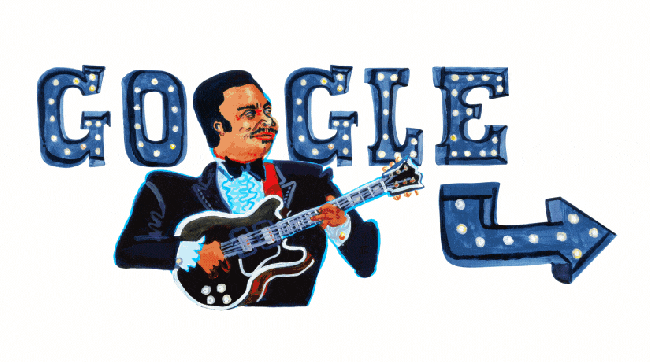
B.B. King’s 94th Birthday! GoogleDoodleGo To TopJavatpoint Logo
Custom Search

Home
Java
C
C++
C
Servlet
JSP
EJB
Struts2
Mail
Hibernate
Spring
Android
Design P
Quiz
Projects
Interview Q
Comment
Forum
Training

Java Tutorial
Java Training
Our core Java programming tutorial is designed for students and working professionals. Java is an object-oriented, class-based, concurrent, secured and general-purpose computer-programming language. It is a widely used robust technology.

What is Java
Java is a programming language and a platform.

Java is a high level, robust, object-oriented and secure programming language.

Platform: Any hardware or software environment in which a program runs, is known as a platform. Since Java has a runtime environment (JRE) and API, it is called a platform.

Java Example
Let's have a quick look at Java programming example. A detailed description of hello Java example is available in next page.

class Simple{
public static void main(String args[]){
System.out.println("Hello Java");
}
}
Test it Now


Application
According to Sun, 3 billion devices run Java. There are many devices where Java is currently used. Some of them are as follows:

Desktop Applications such as acrobat reader, media player, antivirus, etc.
Web Applications such as irctc.co.in, javatpoint.com, etc.
Enterprise Applications such as banking applications.
Mobile
Embedded System
Smart Card
Robotics
Games, etc.
Types of Java Applications
There are mainly 4 types of applications that can be created using Java programming:

1) Standalone Application
Standalone applications are also known as desktop applications or window-based applications. These are traditional software that we need to install on every machine. Examples of standalone application are Media player, antivirus, etc. AWT and Swing are used in Java for creating standalone applications.

2) Web Application
An application that runs on the server side and creates a dynamic page is called a web application. Currently, Servlet, JSP, Struts, Spring, Hibernate, JSF, etc. technologies are used for creating web applications in Java.

3) Enterprise Application
An application that is distributed in nature, such as banking applications, etc. is called enterprise application. It has advantages of the high-level security, load balancing, and clustering. In Java, EJB is used for creating enterprise applications.

4) Mobile Application
An application which is created for mobile devices is called a mobile application. Currently, Android and Java ME are used for creating mobile applications.

Java Platforms / Editions
There are 4 platforms or editions of Java:

1) Java SE (Java Standard Edition)
It is a Java programming platform. It includes Java programming APIs such as java.lang, java.io, java.net, java.util, java.sql, java.math etc. It includes core topics like OOPs, String, Regex, Exception, Inner classes, Multithreading, I/O Stream, Networking, AWT, Swing, Reflection, Collection, etc.

2) Java EE (Java Enterprise Edition)
It is an enterprise platform which is mainly used to develop web and enterprise applications. It is built on the top of the Java SE platform. It includes topics like Servlet, JSP, Web Services, EJB, JPA, etc.

3) Java ME (Java Micro Edition)
It is a micro platform which is mainly used to develop mobile applications.

4) JavaFX
It is used to develop rich internet applications. It uses a light-weight user interface API.

Prerequisite
To learn Java, you must have the basic knowledge of C/C++ programming language.

Audience
Our Java programming tutorial is designed to help beginners and professionals.

Problem
We assure that you will not find any problem in this Java tutorial. However, if there is any mistake, please post the problem in the contact form.

Do You Know?
What is the difference between JRE and JVM?
What is the purpose of JIT compiler?
Can we save the java source file without any name?
Why java uses the concept of Unicode system?
What will we learn in Basics of Java?
History of Java
Features of Java
Hello Java Program
Program Internal
How to set path?
Difference between JDK,JRE and JVM
Internal Details of JVM
Variable and Data Type
Unicode System
Operators

next →

Please Share
facebook twitter google plus pinterest
Join Javatpoint Test Series
Placement Papers
TCS
HCL
Infosys
IBM
Accenture
AMCAT
eLitmas
Java
Python
C Programming
Networking
Bank PO/Clerk
UPSSSC
Government Exams
SSC
Civil Services
SBI
GATE
NEET
CAT
Railway
CTET
IIT JEE
Learn Latest Tutorials
VBA Tutorial
VBA

SSIS Tutorial
SSIS

NGINX Tutorial
NGINX

SSRS Tutorial
SSRS

Blockchain Tutorial
Blockchain

ETL Tutorial
ETL

Bugzilla Tutorial
Bugzilla

Jenkins Tutorial
Jenkins

Pytorch Tutorial
Pytorch

Agile Tutorial
Agile

JIRA Tutorial
JIRA

Tableau Tutorial
Tableau

Preparation
Aptitude
Aptitude

Logical Reasoning
Reasoning

Verbal Ability
Verbal A.

Interview Questions
Interview

Company Interview Questions
Company

Trending Technologies
Artificial Intelligence Tutorial
AI

AWS Tutorial
AWS

Selenium tutorial
Selenium

IoT Tutorial
IoT

Cloud tutorial
Cloud

Hadoop tutorial
Hadoop

ReactJS Tutorial
ReactJS

React Native Tutorial
React Native

Node.js tutorial
Node.js

Data Science Tutorial
D. Science

Angular 7 Tutorial
Angular 7

B.Tech / MCA
DBMS tutorial
DBMS

Data Structures tutorial
DS

DAA tutorial
DAA

Operating System tutorial
OS

Computer Network tutorial
C. Network

Compiler Design tutorial
Compiler D.

Computer Organization and Architecture
COA

Discrete Mathematics Tutorial
D. Math.

Ethical Hacking Tutorial
E. Hacking

Computer Graphics Tutorial
C. Graphics

Software Engineering Tutorial
Software E.

html tutorial
Web Tech.

Cyber Security tutorial
Cyber Sec.

Automata Tutorial
Automata

C Language tutorial
C

C++ tutorial
C++

Java tutorial
Java

.Net Framework tutorial
.Net

Python tutorial
Python

List of Programs
Programs

Control Systems tutorial
Control S.

Comments